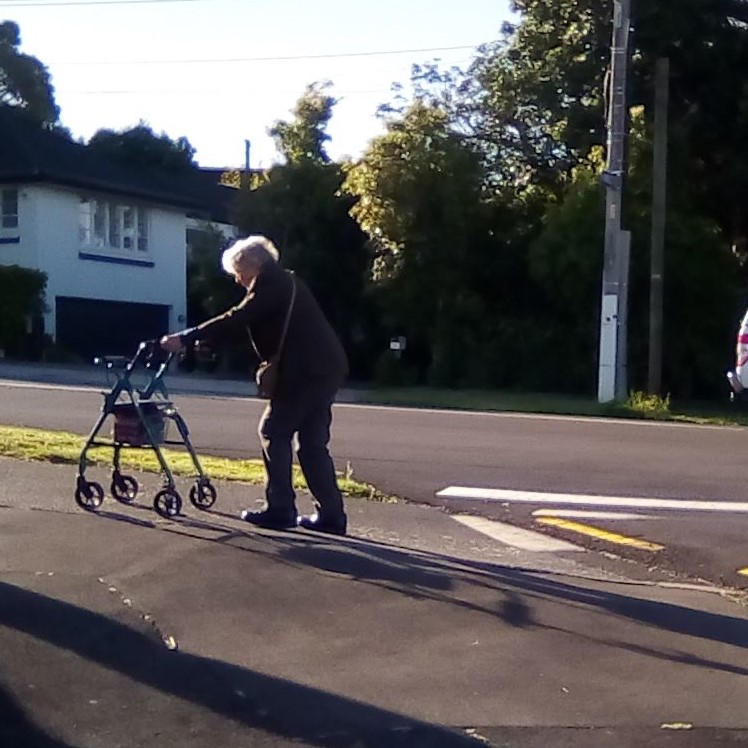
Worldwide, cities aspire to carbon-neutral transport systems, often aiming to reduce inequities of access [1–3]. Enabling and encouraging walking as a mode of transport is a key element of this line of action, and requires (a) addressing barriers people now face [4, 5] and (b) considering walking within the broader transport system (-both as compared to alternatives and/or associated with public transport) [6].
Walkability has had a lot of research interest, especially in the last 10 years and many indices offer to provide a quantitative measure of “walkability” for street segments or neighbourhoods (e.g., WalkScore ™ [7]). However, walkability remains a contested phenomenon. The notion is diversely understood amongst researchers [8, 9] – Ann Forsyth noted for instance three clusters of meanings, related to (a) the walking environment, through measures of objective and/or perceived features; (b) the outcomes, such as for instance public health; and (c) a form of proxy for “better” urban environments [8].
Existing “walkability” indices typically ignore the quality of the walking environment and possible barriers to access, taking a high-level approach, giving a measure of the availability of destinations assumed to be important, within walking ranges assumed feasible.
There is no agreed theoretical model linking walking environment and walking behaviour [9], even though the importance of walking environments is acknowledged [10–12]. Promising research works have however progressed the thinking [9, 13–15]. The Social Model of Walkability is a promising theoretical model linking walking environments to perceived walkability (or: the satisfaction of individual walking needs) and beyond that to walking behaviour [16]. Individual, social, and trip-related characteristics moderate those relationships [16]. The testing to date has confirmed the overall principle of the model, however the understanding of the objective features of the walking environment people might perceive as barriers to walking is insufficient to date [16]. The granularity of walking experiences is not yet understood, with major gaps relating, amongst other things, to disabled people’s experiences, and ways specific perceptions inform an overall experience of a walking route [9, 17].
Improving equity of access requires understanding who experiences the most acute barriers to walking, understanding the nature of those barriers, and addressing them [4, 5]. The lack of understanding of barriers to walking experienced by people with invisible impairments implies however the risk of continued inequities of access. Therefore, it is probable that investment in walkability is allocated in a way that does not prioritise the most acute barriers experienced by people with invisible disabilities – it can be that “nice areas are made nicer” or that those areas that require urgent attention do not get it.
This project contributes advancing the understanding of the associations between environments and experiences, piloting the use of an innovative app (Go Jauntly) as a method for participant-led data collection.
1. Transport for London. (2019). Travel in London: Understanding our diverse communities 2019 – A summary of existing research (p. 315). London: Transport for London. Retrieved from http://content.tfl.gov.uk/travel-in-london-understanding-our-diverse-communities-2019.pdf
2. C40 Cities. (2018). Summary for Urban Policymakers: What the IPCC Special Report on Global Warming of 1.5°C means for Cities (p. 30). C40 Cities. Retrieved from https://www.c40knowledgehub.org/s/article/Summary-for-Urban-Policymakers-What-the-IPCC-Special-Report-on-Global-Warming-of-1-5-C-means-for-cities?language=en_US
3. C40 Cities. (2020). C40 Mayors’ Agenda for a Green and Just Recovery (p. 43). Retrieved from https://www.c40knowledgehub.org/s/article/C40-Mayors-Agenda-for-a-Green-and-Just-Recovery?language=en_US&utm_campaign=Spotlight+On%3A+Green+and+Just+Recovery&utm_medium=Mailchimp&utm_source=Mailchimp
4. Burdett, B. (2018). Transport, participation and wellbeing: Evidence and recommendations (No. 12513917) (p. 70). Hamilton, New Zealand: Waikato Regional Council. Retrieved from https://www.waikatoregion.govt.nz/services/publications/tr201818/
5. Burdett, B. R. D., Locke, S. M., & Scrimgeour, F. (2017). The Economics of Enhancing Accessibility. International Transport Forum Discussion Papers, 21. https://doi.org/10.1787/84eb3253-en
6. Glaser, M., & Krizek, K. J. (2021). Can street-focused emergency response measures trigger a transition to new transport systems? Exploring evidence and lessons from 55 US cities. Transport Policy, 103, 146–155. https://doi.org/10.1016/j.tranpol.2021.01.015
7. Walk Score. (n.d.). WalkScore TM. Walk Score. Retrieved August 28, 2018, from https://www.walkscore.com/
8. Forsyth, A. (2015). What is a walkable place? The walkability debate in urban design. URBAN DESIGN International, 20(4), 274–292. https://doi.org/10.1057/udi.2015.22
9. Bozovic, T., Hinckson, E., & Smith, M. (2020). Why do people walk? Role of the built environment and state of development of a social model of walkability. Travel Behaviour and Society, 20, 181–191. https://doi.org/10.1016/j.tbs.2020.03.010
10. Eisenberg, Y., Vanderbom, K. A., & Vasudevan, V. (2017). Does the built environment moderate the relationship between having a disability and lower levels of physical activity? A systematic review. Preventive Medicine, 95S, S75–S84. https://doi.org/10.1016/j.ypmed.2016.07.019
11. Bigonnesse, C., Mahmood, A., Chaudhury, H., Mortenson, W. B., Miller, W. C., & Ginis, K. A. M. (2018). The role of neighborhood physical environment on mobility and social participation among people using mobility assistive technology. Disability & Society, 33(6), 866–893. https://doi.org/10.1080/09687599.2018.1453783
12. Mindell, J. S., & Karlsen, S. (2012). Community Severance and Health: What Do We Actually Know? Journal of Urban Health, 89(2), 232–246. https://doi.org/10.1007/s11524-011-9637-7
13. Alfonzo, M. (2005). To Walk or Not to Walk? The Hierarchy of Walking Needs. Environment and Behavior, 37(6), 808–836. https://doi.org/10.1177/0013916504274016
14. Mehta, V. (2008). Walkable streets: pedestrian behavior, perceptions and attitudes. Journal of Urbanism: International Research on Placemaking and Urban Sustainability, 1(3), 217–245.
15. Buckley, P., Stangl, P., & Guinn, J. (2016). Why people walk: modeling foundational and higher order needs based on latent structure. Journal of Urbanism: International Research on Placemaking and Urban Sustainability, 10(2). Retrieved from https://doi/abs/10.1080/17549175.2016.1223738
16. Bozovic, T. (2021). Non-walkability in the Car-Centric City (Thesis). Auckland University of Technology. Retrieved from https://openrepository.aut.ac.nz/handle/10292/14729
17. Andrews, G. J., Hall, E., Evans, B., & Colls, R. (2012). Moving beyond walkability: On the potential of health geography. Social Science & Medicine, 75(11), 1925–1932. https://doi.org/10.1016/j.socscimed.2012.08.013
 WalkEE - Walking Environments and Experiences
Leave a comment